









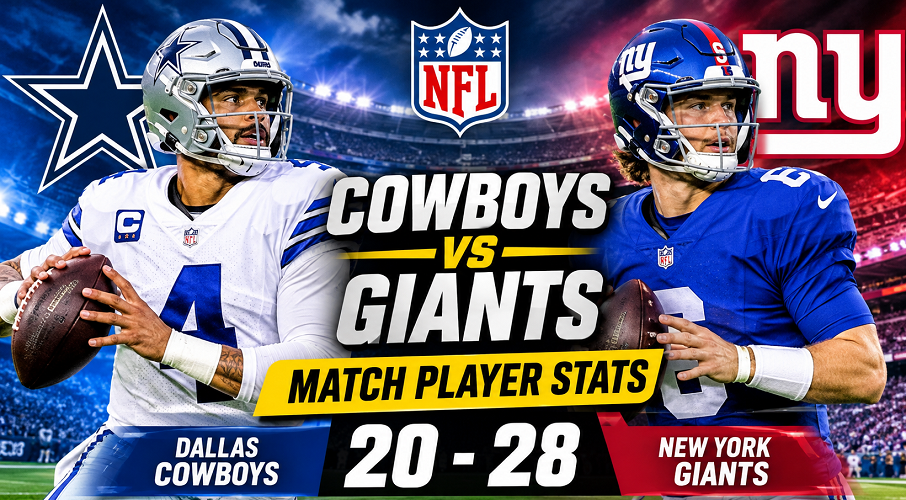
The Dallas Cowboys and New York Giants added another chapter to their NFC East rivalry on September 13, 2026. Their Week 1 matchup at MetLife Stadium ended with a 28-20 victory for New York. The Giants entered the season looking to establish a stronger identity under head coach John Harbaugh. They delivered an impressive opening performance, combining efficient quarterback play with a productive rushing attack. Dallas Cowboys vs New York Giants Match Player Stats. Jaxson Dart led the offence with 230 passing yards and three touchdowns. Cam Skattebo added 81 rushing yards, while Isaiah Likely became one of the game’s biggest offensive weapons. His eight receptions included two touchdown catches.
Dallas had some bright spots of its own. Dak Prescott threw two touchdown passes, and Javonte Williams scored twice. CeeDee Lamb also found the end zone.
However, the Cowboys struggled to maintain possession and generate consistent offensive production. They finished with 244 total yards, well behind New York’s 394.
For fans following the Dallas Cowboys vs New York Giants match player stats, this game offers plenty to examine. The passing numbers, rushing performances, receiving production, and defensive contributions explain how New York controlled the contest.
Also Read: New York Giants vs Philadelphia Eagles Match Player Stats
Dallas Cowboys vs New York Giants Match Overview: Dallas Cowboys vs New York Giants Match Player Stats
The Giants established control early and maintained their advantage throughout the game. Their offence consistently moved the chains, while the defence limited Dallas’s opportunities to build momentum.
Prescott completed 22 of 34 passes, but Dallas struggled to create explosive plays. Meanwhile, Dart completed nearly 80% of his attempts and consistently found open receivers.
The difference wasn’t limited to quarterback performance. New York also dominated the ground game and controlled the clock.
Final Score
| Team | First | Second | Third | Fourth | Final |
|---|---|---|---|---|---|
| Dallas Cowboys | 0 | 7 | 7 | 6 | 20 |
| New York Giants | 7 | 7 | 7 | 7 | 28 |
The Giants scored in every quarter, which helped them avoid a late collapse. Dallas responded after a scoreless opening period but never managed to take the lead.
Game details:
- Date: September 13, 2026
- Competition: NFL Regular Season, Week 1
- Venue: MetLife Stadium
- Location: East Rutherford, New Jersey
- Final result: New York Giants 28, Dallas Cowboys 20
Dallas Cowboys Player Stats
Dallas had several productive individual performances, particularly from its starting quarterback and running back.
Prescott connected with his primary receivers for two touchdowns. Williams also contributed through the air and on the ground.
Nevertheless, the Cowboys needed more consistent production from their offense.
1. Dak Prescott – Quarterback
Prescott completed 22 of 34 passes for 175 yards. He threw two touchdowns and one interception.
| Passing Statistic | Performance |
|---|---|
| Completions | 22 |
| Attempts | 34 |
| Completion Percentage | 64.7% |
| Passing Yards | 175 |
| Passing Touchdowns | 2 |
| Interceptions | 1 |
| Passer Rating | 84.8 |
Prescott showed flashes of his usual accuracy, especially when Dallas approached the red zone. However, the Giants kept most of his passing production in check.
His average of 5.1 yards per attempt reflected the Cowboys’ difficulty stretching the field.
Prescott also contributed 14 rushing yards on two attempts. Still, his overall performance wasn’t enough to overcome New York’s offensive advantage.
2. Javonte Williams – Running Back
Williams delivered one of Dallas’s strongest individual performances. He contributed in both the running and passing games and scored twice.
| Statistic | Performance |
|---|---|
| Rushing Attempts | 12 |
| Rushing Yards | 41 |
| Rushing Touchdowns | 1 |
| Receptions | 5 |
| Receiving Yards | 31 |
| Receiving Touchdowns | 1 |
| Total Yards | 72 |
| Total Touchdowns | 2 |
Williams scored a rushing touchdown in the third quarter before catching a 17-yard touchdown pass from Prescott in the fourth.
His combined production gave Dallas a reliable offensive option. The problem was that the Cowboys couldn’t consistently build their offence around his contributions.
3. CeeDee Lamb – Wide Receiver
Lamb remained an important target in Dallas’s passing attack.
He caught five of eight targets for 44 yards and one touchdown. His one-yard touchdown reception from Prescott tied the game at 7-7 in the second quarter.
| Receiving Statistic | Performance |
|---|---|
| Targets | 8 |
| Receptions | 5 |
| Receiving Yards | 44 |
| Average per Catch | 8.8 |
| Touchdowns | 1 |
| Longest Reception | 15 yards |
Lamb provided reliable hands, but the Giants limited his opportunities to make bigger plays.
Other Notable Cowboys Performances
Several other Dallas players contributed to the passing and return games.
- George Pickens: Three receptions for 28 yards.
- Ryan Flournoy: Two receptions for 22 yards.
- Brevyn Spann-Ford: Two receptions for 14 yards.
- Jake Ferguson: Two receptions for six yards.
- KaVontae Turpin: One reception for eight yards and 122 kickoff return yards.
- Dak Prescott: Added 14 rushing yards.
Turpin’s return production gave Dallas useful field position. Unfortunately, the offence couldn’t consistently turn those opportunities into points.
New York Giants Player Stats: Dallas Cowboys vs New York Giants Match Player Stats
New York’s offence produced the more complete performance.
Dart distributed the ball effectively, Skattebo established the running game, and Likely consistently found openings in Dallas’s coverage.
Malik Nabers also provided a valuable receiving option. His return to the lineup added another dimension to the Giants’ passing attack.
1. Jaxson Dart – Quarterback
Dart was the standout quarterback of the matchup.
He completed 23 of 29 attempts for 230 yards, threw three touchdowns, and avoided interceptions.
| Passing Statistic | Performance |
|---|---|
| Completions | 23 |
| Attempts | 29 |
| Completion Percentage | 79.3% |
| Passing Yards | 230 |
| Passing Touchdowns | 3 |
| Interceptions | 0 |
| Passer Rating | 134.2 |
Dart’s accuracy made a noticeable difference. He completed nearly four out of every five attempts and consistently found productive passing options.
He also contributed 54 rushing yards on 11 attempts. His mobility helped New York extend drives and created additional problems for Dallas’s defence.
The combination of accurate passing and effective scrambling made Dart difficult to contain.
2. Cam Skattebo – Running Back
Skattebo gave the Giants the ground-game production they needed.
He carried the ball 18 times for 81 yards and scored New York’s opening touchdown.
| Rushing Statistic | Performance |
|---|---|
| Carries | 18 |
| Rushing Yards | 81 |
| Average per Carry | 4.5 |
| Rushing Touchdowns | 1 |
| Longest Run | 13 yards |
His three-yard touchdown run gave the Giants an early 7-0 advantage.
Skattebo’s contribution went beyond that opening score. His consistent rushing production helped New York control the clock and prevented Dallas from focusing exclusively on Dart’s passing game.
3. Isaiah Likely – Tight End
Likely delivered one of the best receiving performances of the game.
He caught all eight of his targets for 78 yards and two touchdowns.
| Receiving Statistic | Performance |
|---|---|
| Targets | 8 |
| Receptions | 8 |
| Receiving Yards | 78 |
| Average per Catch | 9.8 |
| Touchdowns | 2 |
| Longest Reception | 19 yards |
Likely scored on a 15-yard reception in the second quarter and added another touchdown on a two-yard catch in the third.
His perfect reception rate demonstrated how effectively Dart used him throughout the contest.
The tight end’s performance also highlighted a weakness in Dallas’s defensive coverage. New York repeatedly found opportunities to involve him in important scoring situations.
4. Malik Nabers – Wide Receiver
Nabers supplied another reliable target for Dart.
He finished with six receptions for 69 yards on nine targets.
| Receiving Statistic | Performance |
|---|---|
| Targets | 9 |
| Receptions | 6 |
| Receiving Yards | 69 |
| Average per Catch | 11.5 |
| Touchdowns | 0 |
| Longest Reception | 16 yards |
Nabers didn’t score, but his contribution remained important.
His ability to gain yards after the catch and move the chains helped New York maintain offensive pressure.
Other Notable Giants Performances
The Giants also received contributions from several supporting players.
- Devin Singletary: Four receptions for 22 yards and one receiving touchdown. He added 16 rushing yards.
- Darnell Mooney: Two catches for 27 yards.
- Malachi Fields: Two catches for 25 yards.
- Theo Johnson: One reception for nine yards.
- Jaxson Dart: Added 54 rushing yards.
- Tyrone Tracy Jr.: Two rushing attempts for 14 yards.
Singletary’s nine-yard touchdown reception in the fourth quarter proved particularly valuable. It extended New York’s lead to 28-14 and put additional pressure on Dallas.
Dallas Cowboys vs New York Giants Player Stats Comparison
The individual performances reveal why New York controlled the game.
Dart outperformed Prescott in passing efficiency and total yardage. Skattebo also produced twice as many rushing yards as Williams.
Likely’s receiving numbers gave the Giants another significant advantage.
Leading Player Comparison
| Category | Dallas Cowboys | New York Giants |
|---|---|---|
| Passing Leader | Dak Prescott | Jaxson Dart |
| Passing Yards | 175 | 230 |
| Passing TDs | 2 | 3 |
| Interceptions | 1 | 0 |
| Leading Rusher | Javonte Williams | Cam Skattebo |
| Rushing Yards | 41 | 81 |
| Leading Receiver | CeeDee Lamb | Isaiah Likely |
| Receiving Yards | 44 | 78 |
| Receiving TDs | 1 | 2 |
Complete Team Statistics
| Team Statistic | Cowboys | Giants |
|---|---|---|
| First Downs | 21 | 29 |
| Total Net Yards | 244 | 394 |
| Net Passing Yards | 175 | 229 |
| Rushing Yards | 69 | 165 |
| Total Plays | 52 | 68 |
| Yards per Play | 4.7 | 5.8 |
| Third-Down Conversions | 8/11 | 9/11 |
| Third-Down Percentage | 72% | 81% |
| Time of Possession | 23:20 | 36:40 |
| Turnovers Lost | 1 | 1 |
| Penalties | 9 | 10 |
| Penalty Yards | 90 | 114 |
One detail stands out: New York gained 150 more total yards than Dallas.
The Giants also controlled possession for more than 13 additional minutes. That advantage allowed their offense to manage the pace and keep the Cowboys’ defense on the field.
The Giants recorded 165 rushing yards compared with Dallas’s 69. This difference played a major role in the final result.
Individual passing totals also differ slightly from team net passing totals because sacks count against team passing yardage.
Defensive Player Stats: Cowboys vs Giants
The offensive performances attracted most of the attention, but defensive contributions also shaped the contest.
Dallas had some strong individual tackling performances. Donovan Ezeiruaku led the Cowboys with 10 total tackles.
Caleb Downs also recorded a sack, while Jevon Holland delivered an important interception for New York.
Dallas Cowboys Defensive Leaders
| Player | Total Tackles | Notable Contribution |
|---|---|---|
| Donovan Ezeiruaku | 10 | Team-leading tackles |
| Jalen Thompson | 9 | Defensive support |
| Caleb Downs | 8 | 1 sack |
| DaRon Bland | 8 | Secondary coverage |
| DeMarvion Overshown | 7 | Run defense |
Ezeiruaku’s 10 tackles showed his involvement throughout the game.
Downs also provided a valuable contribution with his sack. However, Dallas struggled to stop New York’s overall offensive production.
New York Giants Defensive Contributions
Jevon Holland delivered one of the game’s most important defensive plays.
His interception of Prescott late in the first half helped shift momentum toward New York. The Giants capitalized on the opportunity and scored before halftime.
Tremaine Edmunds led the Giants with eight total tackles. Deonte Banks also contributed two passes defended.
The defensive unit limited Dallas to 244 total yards and prevented the Cowboys from building a sustained comeback.
New York’s defense didn’t need to dominate every individual matchup. Its ability to create a key turnover and restrict Dallas’s offensive production proved sufficient.
Key Moments That Decided the Game
The Giants didn’t win through one spectacular play. Instead, they built their advantage through consistent execution across four quarters.
Several moments helped determine the final outcome.
First Quarter: Skattebo Gives New York the Lead
The Giants opened the scoring with a three-yard rushing touchdown from Cam Skattebo.
The early score established momentum and gave New York a 7-0 advantage.
Dallas couldn’t find the end zone during the opening quarter.
Second Quarter: Both Teams Find the End Zone
Prescott connected with CeeDee Lamb for a one-yard touchdown reception. Brandon Aubrey converted the extra point to tie the game at 7-7.
New York responded before halftime.
Dart found Isaiah Likely for a 15-yard touchdown pass, giving the Giants a 14-7 lead.
Holland’s interception of Prescott also helped New York seize control of the closing moments of the first half.
Third Quarter: Likely Extends the Advantage
Dart connected with Likely again, this time for a two-yard touchdown.
The Giants moved ahead 21-7.
Dallas responded with a one-yard rushing touchdown from Williams. The score reduced the deficit to seven points.
However, New York continued to control the overall pace.
Fourth Quarter: Giants Close Out the Victory
Dart connected with Singletary for a nine-yard touchdown pass. The Giants increased their advantage to 28-14.
Dallas answered when Prescott found Williams for a 17-yard touchdown reception.
The Cowboys attempted to make the finish more competitive, but Aubrey missed the extra point.
The Giants protected their eight-point lead and secured the 28-20 victory.
Why the New York Giants Won
The Giants won because they performed more consistently in the areas that matter most.
Their quarterback completed nearly 80% of his passes. Their running game generated 165 yards, and their offense controlled possession for 36 minutes and 40 seconds.
Three factors explain the result particularly well.
1. Better Quarterback Efficiency
Dart completed 23 of 29 passes and threw three touchdowns without an interception.
Prescott also threw two touchdowns, but his completion percentage and passing yardage were lower.
Dart’s ability to protect the football gave New York a clear advantage.
2. Stronger Rushing Production
Skattebo recorded 81 rushing yards, while the Giants finished with 165 team rushing yards.
Dallas managed only 69 rushing yards.
That difference helped New York control the clock and create more opportunities for its passing attack.
3. Better Offensive Execution
The Giants converted nine of 11 third-down opportunities.
Dallas converted eight of 11, which was also a respectable percentage. However, New York created more total first downs and ran significantly more offensive plays.
The Giants also benefited from Holland’s interception and Singletary’s fourth-quarter touchdown.
Together, these contributions helped New York maintain control.
Pros and Cons: Both Teams’ Performances
Both teams showed positive signs, but their weaknesses became clear during the matchup.
Dallas Cowboys
Pros
- Prescott delivered two passing touchdowns.
- Williams scored twice.
- Lamb caught a touchdown pass.
- Turpin recorded 122 kickoff return yards.
- Several defenders produced strong tackling performances.
Cons
- Dallas finished with only 244 total yards.
- Prescott threw one interception.
- The rushing offense averaged 3.8 yards per carry.
- The Cowboys controlled possession for just 23:20.
- Dallas failed to score in the first quarter.
New York Giants
Pros
- Dart threw three touchdowns without an interception.
- Skattebo rushed for 81 yards.
- Likely caught eight passes for 78 yards and two touchdowns.
- New York gained 394 total yards.
- The Giants controlled possession for 36:40.
Cons
- New York committed 10 penalties for 114 yards.
- The defense allowed two passing touchdowns.
- Dallas remained within one score late in the game.
- The Giants could have reduced unnecessary penalties.
Expert Tips: How to Analyze Cowboys vs Giants Player Stats
A box score contains more information than the final score. Understanding the relationship between different statistics provides a clearer picture of individual and team performance.
Here are five useful ways to evaluate this matchup.
1. Compare Quarterback Efficiency
Passing yards alone don’t determine quarterback performance.
Look at completion percentage, yards per attempt, touchdowns, interceptions, and passer rating.
Dart’s 134.2 passer rating compared favorably with Prescott’s 84.8. His ability to avoid interceptions also helped New York maintain control.
2. Evaluate Combined Rushing and Receiving Production
Running backs can influence a game without recording huge rushing totals.
Williams finished with 72 combined yards and two touchdowns. Skattebo recorded 81 rushing yards and one touchdown.
For fantasy football analysis, combined production provides a better picture of a running back’s value.
3. Examine Red-Zone Execution
Teams must convert scoring opportunities into touchdowns.
The Giants went 4-for-4 in red-zone opportunities, while Dallas finished 3-for-3.
Both offenses converted their trips successfully, but New York created more scoring opportunities overall.
4. Consider Time of Possession
Possession statistics help explain which team controlled the game.
New York held the ball for 36:40, compared with Dallas’s 23:20.
That difference gave the Giants more opportunities to run plays and manage the game clock.
5. Separate Individual and Team Performance
A player can produce strong numbers even when his team loses.
Prescott threw two touchdowns, and Williams scored twice. Both delivered valuable individual performances despite Dallas’s defeat.
For a more complete analysis, compare individual production with the team’s overall offensive results.
(FAQs): About Dallas Cowboys vs New York Giants Match Player Stats
1. Who won the Dallas Cowboys vs New York Giants game in 2026?
The New York Giants defeated the Dallas Cowboys 28-20 on September 13, 2026. The game took place at MetLife Stadium in East Rutherford, New Jersey.
2. What were Dak Prescott’s stats against the Giants?
Prescott completed 22 of 34 passes for 175 yards. He threw two touchdown passes and one interception. His passer rating was 84.8.
3. How many passing yards did Jaxson Dart record?
Dart recorded 230 passing yards against Dallas. He completed 23 of 29 attempts, threw three touchdowns, and avoided interceptions.
4. Who had the most rushing yards in the game?
Cam Skattebo led all players with 81 rushing yards. He carried the ball 18 times and scored one rushing touchdown.
5. How did CeeDee Lamb perform against the Giants?
Lamb recorded five receptions for 44 yards and one touchdown. He led Dallas in receiving yards during the game.
6. How many touchdowns did Isaiah Likely score?
Likely caught two touchdown passes from Jaxson Dart. He finished with eight receptions for 78 yards.
7. Which team recorded more total yards?
The New York Giants gained 394 total net yards. Dallas finished with 244 yards, giving New York a 150-yard advantage.
8. How long did each team control possession?
The Giants controlled the ball for 36 minutes and 40 seconds. Dallas held possession for 23 minutes and 20 seconds.
9. Who scored the final touchdown?
Javonte Williams scored the Cowboys’ final touchdown on a 17-yard reception from Dak Prescott in the fourth quarter. Dallas missed the extra point afterward.
10. Where can fans find the complete Cowboys vs Giants box score?
Fans can review passing, rushing, receiving, defensive, and special-teams statistics through established football statistics websites.
Useful resources include:
- NFL.com for official league information and schedules.
- Pro Football Reference for detailed historical box scores.
- FOX Sports for player statistics and team comparisons.
- CBS Sports for game trackers and fantasy football statistics.
Conclusion: Dallas Cowboys vs New York Giants Match Player Stats
The September 13, 2026, matchup between the Dallas Cowboys and New York Giants delivered a strong opening-week performance from New York.
The Giants earned their 28-20 victory through efficient quarterback play, a productive rushing attack, and reliable receiving performances.
Jaxson Dart led the offense with 230 passing yards and three touchdowns. Cam Skattebo added 81 rushing yards, while Isaiah Likely caught eight passes for 78 yards and two scores.
Dallas also had individual standouts. Prescott threw two touchdown passes, Williams scored twice, and Lamb contributed another touchdown.
However, the Cowboys couldn’t match New York’s offensive production. The Giants gained 150 more total yards and controlled possession for more than 13 additional minutes.
For fans researching Dallas Cowboys vs New York Giants match player stats, this game offers a clear example of how quarterback efficiency, rushing production, and possession can shape an NFL result.
One thought on “Dallas Cowboys vs New York Giants Match Player Stats 2026”