









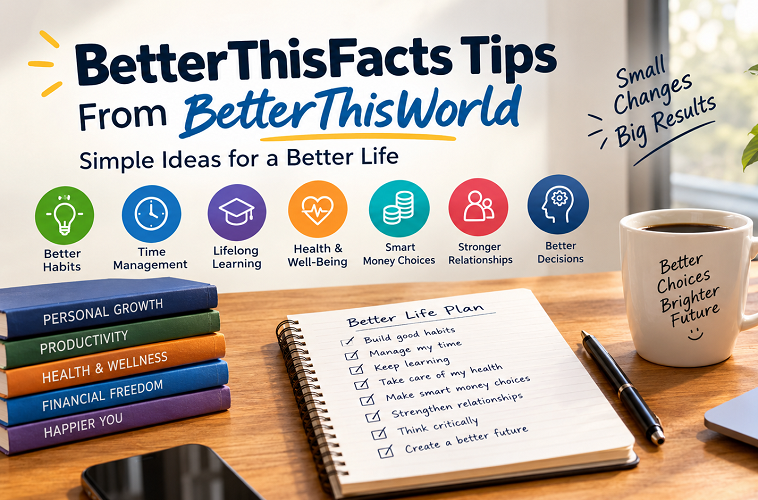
YImproving your life doesn’t always require a major change. Sometimes, a better routine, a smarter decision, or a small daily habit can make a lasting difference. That’s the idea behind BetterThisFacts tips from BetterThisWorld. The phrase points readers toward practical knowledge, everyday insights, and personal development advice they can use at home, at work, or while pursuing their goals.
But useful advice needs more than an appealing headline. It should offer clear explanations, realistic suggestions, and information readers can trust. A tip that sounds convincing isn’t necessarily accurate, especially when it involves health, money, or important life decisions.
This guide explores the ideas associated with BetterThisFacts tips from BetterThisWorld and shows how to put similar principles into practice. From managing your time to building healthier habits, you’ll find actionable strategies for everyday life.
The goal isn’t to change everything overnight. It’s to identify what matters, make thoughtful choices, and build routines that work for you.
Also Read: PlayBattleSquare Global Sensation Was Skins
What Are BetterThisFacts Tips From BetterThisWorld?
BetterThisFacts tips from BetterThisWorld are search phrases associated with practical information, everyday advice, and self-improvement. People searching for this topic may want straightforward answers to common questions or simple ways to improve their daily routines.
The phrase brings together three closely related ideas.
- Facts: Information that helps explain a subject or clarify a question.
- Tips: Practical suggestions that readers can apply to real situations.
- Personal development: Habits and decisions that support learning, productivity, and well-being.
The most useful advice connects these ideas. It explains a concept, shows why it matters, and gives readers a realistic way to apply it.
Consider the difference between being told to get organised and receiving a specific recommendation to spend five minutes planning the following day. The second suggestion gives you a clear starting point.
That principle applies to nearly every area of life, including education, fitness, budgeting, and communication.
Why Do People Search for Practical Tips?
Most people don’t need another complicated system to manage their lives. They need solutions that fit their schedules, budgets, and responsibilities.
Short, practical advice can make unfamiliar subjects easier to understand. A simple explanation of compound interest, for example, may encourage someone to learn more about saving and investing.
However, convenience shouldn’t replace careful research. Readers should check the original source, consider the evidence, and determine whether a recommendation suits their circumstances.
1. Build Better Habits by Starting Small
Big goals can be motivating, but they can also feel overwhelming. When a new routine demands too much time or effort, maintaining it becomes difficult.
Starting small makes the process more manageable. Rather than attempting a complete lifestyle overhaul, choose one behaviour you can repeat consistently.
Make Your Goals Easier to Follow
Suppose you want to read more. Committing to 50 pages every day might work during a quiet week but become difficult when your schedule fills up.
Try reading five pages instead. Once the routine becomes comfortable, increase the target if necessary.
You can apply the same approach to other goals:
- Walk for 10 minutes after lunch.
- Read a page or two before bed.
- Spend five minutes organising your workspace.
- Practice a new language for 10 minutes a day.
- Review your priorities before beginning work.
These actions require little preparation, making them easier to fit into an ordinary day.
Connect New Habits to Existing Routines
An established routine can remind you to perform a new behaviour.
For example, review your daily goals after brushing your teeth each morning. If you already make coffee every afternoon, use that moment to stretch or read a few pages.
Over time, the familiar activity can become a natural reminder.
Practical tip: Track your progress with a calendar or simple checklist. Don’t abandon a habit because you miss one day. Resume the routine and focus on consistency rather than perfection.
2. Manage Your Time Without Feeling Constantly Busy
A packed schedule doesn’t automatically mean you’re making progress. You can spend an entire day answering messages and handling minor tasks while your most important work remains unfinished.
Better time management begins with deciding where your attention belongs.
Identify Your Three Main Priorities
Before starting your day, choose three tasks that deserve your attention. These might include finishing a work assignment, preparing for an exam, or handling an important family responsibility.
Complete the most demanding task when your schedule and energy allow.
This approach gives your day direction. It also helps you distinguish meaningful work from activities that simply keep you occupied.
Make Distractions Less Convenient
Concentration becomes harder when notifications, messages, and unrelated tasks constantly interrupt you. Instead of relying entirely on willpower, make a few changes to your environment.
- Silence nonessential notifications.
- Close browser tabs you don’t need.
- Keep your phone out of reach during focused work.
- Break large assignments into smaller tasks.
- Take short breaks between work sessions.
One option is the Pomodoro technique: work for 25 minutes, then take a five-minute break. Adjust the intervals to match your needs.
Create a Daily Schedule That Works
A realistic schedule balances focused work with routine responsibilities and recovery time.
| Time | Activity | Main Benefit |
|---|---|---|
| Morning | Review your priorities. | Establish a clear plan. |
| First work session | Tackle a demanding task | Protect concentration. |
| Midday | Eat and take a short walk. | Recharge |
| Afternoon | Handle routine responsibilities. | Maintain momentum. |
| Evening | Review the day. | Identify improvements. |
Use this schedule as a guide, not a rigid set of rules. Work hours, family commitments, and energy levels differ from person to person.
The best productivity system is one you can maintain without adding unnecessary stress.
3. Make Learning Part of Your Daily Routine: BetterThisFacts Tips From BetterThisWorld
Learning remains valuable long after formal education ends. New skills can improve career opportunities, support personal interests, and help you make better decisions.
You don’t need an expensive course or hours of free time to get started.
Focus on One Useful Skill at a Time
Choose a subject that connects to a real goal. You might improve your writing, learn spreadsheet basics, explore personal finance, or develop a professional skill.
Use reliable books, educational institutions, and reputable learning platforms. When studying a technical subject, look for resources written or reviewed by people with relevant expertise.
After each session, explain the main idea in your own words. This helps you identify gaps in your understanding.
For example, after learning about compound interest, calculate how regular savings might grow over time. Use realistic assumptions, and remember that investment returns aren’t guaranteed.
Put New Knowledge to Work
Reading and watching tutorials can introduce useful concepts, but practical experience helps you understand how they work.
If you learn a writing technique, revise a paragraph. ou study a computer program, complete a small project. If you explore budgeting, compare the method with your actual expenses.
You may discover that a technique works differently in practice than it appeared in theory. That’s part of the learning process.
Avoid Consuming Information Without Applying It
It’s easy to spend hours watching educational videos without making meaningful progress.
Choose one resource, focus on a specific topic, and apply what you’ve learned before moving on.
A concentrated 20-minute session can be more valuable than an hour of distracted browsing.
4. Develop a More Resilient Mindset: BetterThisFacts Tips From BetterThisWorld
A healthy mindset doesn’t mean staying positive all the time. It means responding to challenges realistically, learning from experience, and recognising what you can control.
That distinction matters because some problems require patience, outside support, or changes in circumstances rather than a more positive attitude.
Turn Vague Goals Into Specific Actions
Consider the difference between these two goals:
- “I want to become more confident.”
- “I’ll prepare three talking points before my next meeting.”
The first describes a desired outcome. The second gives you something concrete to practice.
Specific actions make progress easier to recognise. They also help you decide what to do when motivation fades.
Learn From Mistakes Without Dwelling on Them
When something goes wrong, examine what happened before deciding how to respond.
If you miss a deadline, perhaps the task required more research than expected. You might also have underestimated other responsibilities or started too late.
Use those observations to improve your next plan.
At the same time, recognise that not every setback results from a personal mistake. Unexpected events, limited resources, and circumstances outside your control can affect outcomes.
Focus on the parts you can change rather than blaming yourself for everything.
Make Time for Reflection
A few minutes of reflection can help you recognise patterns in your decisions.
At the end of the day, ask yourself:
- What went well?
- What could I have handled differently?
- What’s one useful action I can take tomorrow?
Write down brief answers if that helps. Keep the exercise constructive instead of turning it into a list of shortcomings.
Regular reflection can help you make more deliberate choices and recognise progress that might otherwise go unnoticed.
5. Take Care of Your Physical and Mental Well-Being
Personal goals are harder to maintain when you consistently neglect your health. Sleep, movement, nutrition, and time to recover all influence how you feel and function.
The most useful health advice supports sustainable routines rather than promising dramatic results.
Protect Your Sleep
Most adults need at least seven hours of sleep each night, although individual needs vary.
Try to maintain a reasonably consistent bedtime and wake-up time. Keep your bedroom comfortable, and reduce stimulating activities before bed.
If sleep difficulties persist or interfere with your daily life, consult a qualified healthcare professional.
Find Ways to Move More
Exercise doesn’t have to involve an expensive gym membership or an elaborate training plan.
Walking, cycling, dancing, gardening, and recreational sports can all help you become more active.
U.S. health guidance generally recommends that adults get at least 150 minutes of moderate-intensity aerobic activity each week, along with muscle-strengthening activities on two days.
Start at a level that suits your current fitness and health. Increase activity gradually rather than forcing yourself into an unrealistic routine.
Make Balanced Food Choices
Build meals around a variety of foods, including vegetables, fruits, whole grains, and suitable protein sources.
Planning meals before grocery shopping can make everyday choices easier. It may also help you reduce food waste and avoid relying on expensive convenience meals.
Be skeptical of claims that a single ingredient can solve complex health problems. Overall eating patterns matter more than supposed miracle foods.
Make Room for Mental Rest
Constant activity leaves little time to recover from stress.
Take breaks, spend time outdoors, enjoy a hobby, or talk with someone you trust. Not every free moment needs to become another opportunity for productivity.
If emotional distress becomes persistent or overwhelming, professional support may help you manage it.
6. Make Smarter Financial Decisions: BetterThisFacts Tips From BetterThisWorld
Financial stability starts with understanding your income, expenses, and obligations. Even small improvements in how you manage money can help you make more informed choices.
You don’t need a complicated financial system to begin.
Track Where Your Money Goes
Record your expenses for a month. Include rent or housing costs, groceries, transportation, subscriptions, bills, and smaller purchases.
Then group the expenses into categories.
You may discover that several subscriptions or frequent small purchases account for more of your spending than you realized.
The purpose isn’t to eliminate every enjoyable purchase. It’s to understand your habits and decide whether your money supports your priorities.
Build a Budget Around Your Real Income
Start with essential expenses, minimum debt payments, and family responsibilities. Then consider savings and discretionary spending.
If your income changes from month to month, base your plan on a conservative estimate rather than your highest-earning month.
Review the budget regularly and make adjustments when your circumstances change.
Start an Emergency Fund
Unexpected expenses can disrupt even a carefully planned budget.
Begin by setting aside an amount you can afford. Your first goal might cover a minor repair or an urgent bill. As your circumstances allow, build toward a larger reserve.
Keep emergency savings accessible and separate from money used for routine purchases.
If you have expensive debt, consider its interest costs alongside your need for accessible savings. The right balance depends on your financial situation and the consequences of an unexpected expense.
Question Financial Claims You See Online
Be cautious of anyone promising guaranteed profits, effortless income, or unusually high returns without risk.
Research the product, understand the fees, and check withdrawal restrictions before committing money. For significant decisions, use trustworthy financial education resources or seek qualified advice.
Reliable financial guidance helps you understand trade-offs. It shouldn’t pressure you into buying a product.
7. Improve Your Relationships Through Clear Communication
Personal development isn’t only about individual goals. The way you listen, express yourself, and respond to other people also shapes your everyday life.
Healthy relationships often depend on trust, respect, and consistent communication.
Listen Before Offering Advice
When someone shares a problem, resist the urge to interrupt with an immediate solution.
Ask a question or summarize what you heard to make sure you understand.
For example, you might say, “It sounds like the deadline changed unexpectedly. Is that what caused the problem?”
This gives the other person room to explain and reduces the risk of misunderstanding their concerns.
Explain What You Need
People can’t always guess what you expect from them.
Instead of hoping someone will recognize your needs, make a clear request. You could say, “I need an hour to finish this assignment. Can we discuss the plan afterward?”
A calm, direct explanation gives the other person a better opportunity to respond.
Set Boundaries Without Being Disrespectful
Being helpful doesn’t require accepting every request.
If a commitment conflicts with your responsibilities, explain what you can realistically manage. Offer an alternative when appropriate, but don’t promise something you cannot deliver.
Healthy boundaries protect your time and help you maintain relationships without creating unnecessary resentment.
8. Use Technology More Intentionally: BetterThisFacts Tips From BetterThisWorld
Digital tools make it easier to communicate, learn, and manage daily tasks. However, constant notifications and endless scrolling can take up time without adding much value.
The goal isn’t to avoid technology. It’s to use it in ways that support your priorities.
Review Your Screen Time
Check your device’s screen-time report if the feature is available.
Identify the apps that help you learn or stay organized. Then look at the ones that repeatedly interrupt your work.
You could turn off unnecessary notifications, set reasonable app limits, or keep your phone away during study sessions.
Small adjustments can make technology less distracting without requiring you to give it up.
Protect Your Personal Information
Good digital habits also include basic online security.
- Use unique passwords for important accounts.
- Enable multifactor authentication where available.
- Install security updates promptly.
- Check website addresses before entering sensitive information.
- Avoid unexpected links requesting passwords or payment details.
- Review app permissions and privacy settings.
These steps reduce common security risks, although no method guarantees complete protection.
Verify Information Before Sharing It
An interesting fact can spread quickly even when the original claim is inaccurate.
Before sharing a surprising statistic, health recommendation, or financial claim, look for the original source. Check when the information was published and whether the evidence supports the conclusion.
For important subjects, compare multiple credible sources.
This habit is especially useful when evaluating BetterThisFacts tips from BetterThisWorld or advice from similar informational websites.
9. Strengthen Your Critical Thinking Skills
Good decisions require more than finding advice that sounds convincing. You need to evaluate the evidence, compare alternatives, and understand the possible consequences.
Critical thinking helps you distinguish useful recommendations from unsupported claims.
Ask Questions About the Evidence
When you encounter a recommendation, ask:
- What evidence supports this claim?
- Who created the information, and what expertise do they have?
- Is the information current?
- Are important limitations or risks missing?
- Can I verify the claim independently?
These questions are particularly useful when evaluating health information, financial products, and online business opportunities.
Compare Your Options Carefully
Imagine you’re choosing between two online courses. One costs $300, while another costs $50.
Don’t assume the expensive course offers better instruction. Compare the curriculum, instructor qualifications, practical exercises, reviews, and refund policies.
The same principle applies to purchases, career choices, and educational opportunities. A thoughtful comparison helps you judge value rather than relying on price or advertising alone.
Recognize Confirmation Bias
People often pay more attention to information that supports their existing beliefs. This tendency, known as confirmation bias, can influence decisions without us realizing it.
To challenge it, consider a reasonable alternative explanation. Look for credible evidence that might change your opinion instead of searching only for agreement.
You don’t need to analyze every small decision this way. Save the extra scrutiny for choices with meaningful consequences.
10. Create a Personal Growth Plan You Can Follow
Reading advice is a starting point. Real progress comes from choosing useful ideas and applying them consistently.
A simple personal growth plan can help you turn general intentions into specific actions.
Choose One Goal for the Next 30 Days
Pick an area you genuinely want to improve. It might involve studying, reading, exercise, budgeting, or reducing digital distractions.
Write down the result you want and the actions that will move you toward it.
For example, suppose you want to develop a more consistent study routine.
Your plan could include:
- Study for 25 minutes each weekday.
- Put your phone away during each session.
- Review difficult material at the end of the week.
- Record completed sessions on a calendar.
- Adjust the schedule if it repeatedly conflicts with other responsibilities.
This approach makes the goal manageable and gives you a way to monitor your progress.
Measure Progress Without Becoming Obsessed
Choose a few indicators that reflect your actual goal.
If you want to read more, record how often you read. You’re improving your finances, compare planned spending with actual expenses. If you’re exercising regularly, track your activity sessions.
Review your results weekly. Keep the methods that help and adjust those that don’t.
Progress rarely follows a perfectly straight line. A flexible plan makes it easier to continue after interruptions without treating every setback as failure.
Comparison Table: Which BetterThisFacts Tips Should You Try First?
Different strategies address different needs. Use the following comparison to identify a practical place to begin.
| Goal | Recommended Tip | Daily Action | Progress Measure |
|---|---|---|---|
| Improve productivity | Set three priorities | List three important tasks | Tasks completed |
| Build a habit | Start small | Repeat one manageable behavior | Days practiced |
| Learn a skill | Practice actively | Complete a short exercise | Exercises completed |
| Improve health | Move regularly | Walk or exercise | Activity sessions |
| Save money | Track expenses | Record purchases | Spending against budget |
| Reduce distractions | Limit notifications | Silence nonessential alerts | Focused work sessions |
| Strengthen relationships | Listen actively | Ask clarifying questions | Communication improvements |
| Improve decisions | Verify information | Check the supporting evidence | Claims reviewed |
Use these measures to understand your progress, not to guarantee a particular result. Adjust them to fit your circumstances.
Pros and Cons of BetterThisFacts Tips From BetterThisWorld
Practical advice can encourage positive changes, but it works best when readers evaluate it carefully.
Pros
- Easy to apply: Clear recommendations can turn broad goals into manageable actions.
- Time-efficient: Many useful ideas take only a few minutes to understand.
- Encourages learning: Interesting facts can inspire readers to explore unfamiliar subjects.
- Supports consistency: Simple routines may be easier to maintain than complicated systems.
- Promotes reflection: Practical guidance can help readers identify areas for improvement.
- Accessible to beginners: Many everyday habits require little money or specialized equipment.
Cons
- Limited context: Short tips may overlook individual needs and circumstances.
- Unverified claims: Some online content presents opinions as established facts.
- Oversimplified solutions: Complex health, financial, and personal problems rarely have one universal answer.
- Information overload: Reading too many tips can distract you from taking action.
- Unrealistic expectations: Motivational advice may overlook external barriers that affect success.
The answer isn’t to accept or reject every recommendation. Choose advice that addresses a genuine need, check its credibility, and test it on a manageable scale.
Expert Tips for Getting More Value From BetterThisFacts Advice
A few simple principles can help you turn general information into meaningful action.
1. Check the Original Source
If an article includes a statistic, scientific study, or expert recommendation, look for the original publication whenever possible.
For scientific claims, consider whether the evidence comes from a single study, a systematic review, or an established public health organization.
A confident tone doesn’t make a claim accurate.
2. Turn Each Useful Tip Into an Action
After reading an article, select one recommendation and decide when you’ll use it.
If the advice concerns reducing distractions, schedule one focused work session. If it concerns budgeting, record your spending today.
You don’t need to apply every suggestion at once. Testing one idea is more useful than collecting dozens without acting on them.
3. Adapt Advice to Your Circumstances
A routine that works for one person may not suit another.
Someone working night shifts needs a different schedule from someone attending morning classes. Likewise, a person supporting a family may have different financial priorities from someone living independently.
Treat general advice as a starting point. Adjust it to your needs, responsibilities, and resources.
4. Give New Habits Time to Develop
Don’t expect every new routine to feel natural immediately.
Repeat the behavior, notice what makes it easier, and change your environment when necessary. If a habit repeatedly fails, consider whether the goal is too ambitious or the timing is unsuitable.
Consistency matters, but flexibility helps you maintain it.
5. Protect Your Time and Money
Be careful when an informational article leads directly to an expensive product, paid program, or opportunity promising extraordinary results.
Check the costs, terms, alternatives, and potential risks before committing. Consider whether the product offers meaningful value beyond free resources.
Paid products sometimes provide useful structure or specialized instruction. However, price alone doesn’t prove quality.
6. Aim for Sustainable Improvement
You don’t need to optimize every minute of your day.
Leave room for rest, friendships, entertainment, and activities you enjoy. Personal development should support a fulfilling life, not turn every experience into another performance target.
(FAQs): About BetterThisFacts Tips From BetterThisWorld
1. What are BetterThisFacts tips from BetterThisWorld?
BetterThisFacts tips from BetterThisWorld is a search phrase associated with practical advice, useful facts, and personal development. People searching for it may be interested in productivity, habit-building, learning, relationships, and everyday decision-making. Verify specific claims against reliable sources.
2. Is BetterThisFacts from BetterThisWorld a reliable source?
Reliability depends on the specific article, its author, and the evidence it provides. Check publication dates, author credentials, references, and links to original research. Don’t assume every claim is accurate simply because it appears on an informational website.
3. How can I apply BetterThisFacts tips to everyday life?
Start with one area you want to improve. Choose a practical recommendation, turn it into a small action, and repeat it consistently. Review your progress weekly, then adjust your approach if necessary.
4. Which BetterThisFacts tips are best for productivity?
Start by identifying three daily priorities, reducing unnecessary notifications, and scheduling focused work sessions. Break large assignments into smaller tasks. At the end of each day, review your progress and identify what helped you work more effectively.
5. Can BetterThisFacts tips help with personal growth?
Practical tips can support personal growth by encouraging learning, self-reflection, healthier routines, and better decision-making. However, reading advice alone rarely creates lasting change. Results depend on how you apply suitable recommendations and respond to obstacles.
6. Are BetterThisFacts tips suitable for students?
Yes. Students can use practical guidance to improve study planning, revision, time management, and concentration. For example, they can schedule focused study sessions, practice recalling information without notes, and review difficult topics regularly.
7. Can these tips help me save money?
Budgeting suggestions can help you track expenses, identify unnecessary purchases, and establish realistic savings goals. Begin by recording your income and spending. For complex financial decisions, consult qualified professionals or trustworthy financial education resources.
8. How long does it take to develop a new habit?
There is no universal timeline for habit formation. The process depends on the behavior, the individual, and the circumstances. Start with a manageable action, repeat it in a consistent context, and adjust your approach when obstacles arise.
9. How do I know whether an online fact is trustworthy?
Look for the original source, check the publication date, and compare the claim with independent, credible references. For health and science topics, prioritize recognized institutions and well-supported research. Be cautious of dramatic claims that lack evidence or clear explanations.
10. What is the best way to use BetterThisFacts tips from BetterThisWorld?
Use the advice as a starting point for informed action. Select a tip that addresses a real need, verify important claims, and try the recommendation in a realistic way. Keep what helps and discard what doesn’t. For specialized health, legal, or financial concerns, seek appropriate professional guidance.
Conclusion: BetterThisFacts Tips From BetterThisWorld
BetterThisFacts tips from BetterThisWorld is a topic that appeals to readers looking for practical knowledge and ideas for personal improvement. The most useful advice helps people solve everyday problems, make informed decisions, and develop routines that support their goals.
Start with the fundamentals. Manage your time, build manageable habits, keep learning, protect your well-being, and understand your finances. Just as importantly, question unsupported claims and adapt recommendations to your circumstances.
You don’t need to change everything at once. Choose one useful idea and put it into practice today.
With consistent effort and realistic expectations, small actions can help you develop new skills, improve everyday routines, and make more thoughtful choices. Ultimately, the value of any tip comes down to what it helps you understand or do—not how impressive it sounds.