









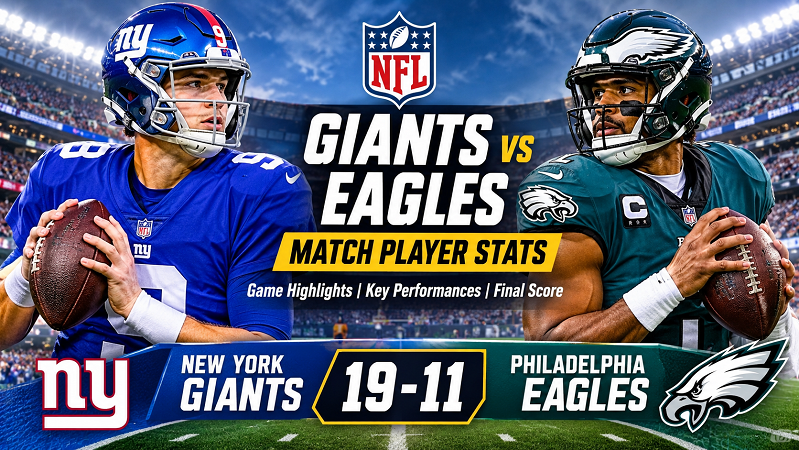
The New York Giants made a statement in their NFC East matchup against the Philadelphia Eagles on November 8, 2026. Playing at Lincoln Financial Field, New York secured a 19-11 victory through aggressive defence, timely scoring, and reliable special teams. New York Giants vs Philadelphia Eagles Match Player Stats. The Giants didn’t overwhelm Philadelphia offensively. Instead, they won by controlling the pace and making crucial plays when opportunities appeared.
Linebacker Arvell Reese led the defensive effort with 12 tackles and three sacks. His performance kept Eagles quarterback Joe Milton under constant pressure. On offence, Isaiah likely caught a touchdown pass, while kicker Dominic Zvada converted all four field-goal attempts.
Philadelphia had some encouraging individual performances. Milton rushed for 64 yards, and receiver Makai Lemon led the Eagles with 61 receiving yards. However, the offence struggled to sustain drives and couldn’t produce a passing touchdown.
The final score reflected those problems.
This detailed breakdown of New York Giants vs Philadelphia Eagles match player stats examines quarterback performances, rushing and receiving numbers, defensive contributions, special teams, and the moments that shaped the result.
Whether you’re comparing individual players or studying the teams’ overall performances, these statistics provide a closer look at how New York earned its divisional victory.
Also Read: eTrueSports iOS App
New York Giants vs Philadelphia Eagles: Final Score and Game Overview
The Giants entered Week 9 looking to improve their position in the NFC East. Philadelphia had home-field advantage but couldn’t turn it into a victory.
New York won 19-11 after a defensive performance that repeatedly disrupted the Eagles’ offence.
Philadelphia started quickly, scoring eight points in the opening quarter. The Giants responded by gradually taking control. Their defence limited Philadelphia’s scoring opportunities, while the offence found enough production to build a winning advantage.
New York finished with 243 total yards. Philadelphia recorded 220. The Giants also controlled possession for 34 minutes and 45 seconds, giving their defence more time to rest between possessions.
Final Score
| Team | Q1 | Q2 | Q3 | Q4 | Final |
|---|---|---|---|---|---|
| New York Giants | 6 | 0 | 7 | 6 | 19 |
| Philadelphia Eagles | 8 | 0 | 0 | 3 | 11 |
Game details:
- Date: November 8, 2026
- Competition: NFL Regular Season
- Week: 9
- Venue: Lincoln Financial Field
- Location: Philadelphia, Pennsylvania
- Final result: New York Giants 19, Philadelphia Eagles 11
1. Quarterback Statistics: Giants vs Eagles
Quarterback play shaped much of the afternoon. Neither team’s starting quarterback produced a passing touchdown, but New York received an important contribution from its backup.
J.J. McCarthy’s performance for the Giants
J.J. McCarthy started at quarterback for New York. He completed 12 of 19 passes for 127 yards without throwing an interception.
He also added 22 rushing yards on four attempts.
McCarthy briefly left the game after suffering a hip injury during a scramble. His departure forced the Giants to adjust their offensive approach.
Although his passing numbers weren’t spectacular, he avoided costly mistakes and helped New York move the football.
Jameis Winston provides an important spark.
Jameis Winston entered the game after McCarthy’s departure. He completed six of eight passes for 71 yards and delivered the Giants’ only passing touchdown.
His five-yard connection with Isaiah Likely capped an important 76-yard scoring drive.
Winston’s contribution proved valuable in a game where offensive touchdowns were difficult to produce.
McCarthy later returned after receiving medical clearance.
Giants quarterback statistics
| Player | Completions | Attempts | Passing Yards | TD | INT |
|---|---|---|---|---|---|
| J.J. McCarthy | 12 | 19 | 127 | 0 | 0 |
| Jameis Winston | 6 | 8 | 71 | 1 | 0 |
| Combined | 18 | 27 | 198 | 1 | 0 |
Joe Milton’s performance for Philadelphia
Joe Milton completed 18 of 34 passes for 169 yards. He didn’t throw a touchdown or interception.
His passing production showed some ability to move the offence, but the Giants’ defensive pressure made consistency difficult.
Milton found more success on the ground. He carried the football nine times for 64 yards, averaging 7.1 yards per attempt.
His longest run covered 24 yards.
That mobility gave Philadelphia another offensive option when passing plays broke down. Unfortunately, it wasn’t enough to overcome New York’s defensive performance.
Eagles quarterback statistics
| Player | Completions | Attempts | Passing Yards | TD | INT |
|---|---|---|---|---|---|
| Joe Milton | 18 | 34 | 169 | 0 | 0 |
Quarterback comparison: Milton finished with more passing yards than either Giants quarterback individually. However, McCarthy and Winston combined for a touchdown without throwing an interception. Winston’s scoring connection with Likely also gave New York an important advantage.
2. Rushing Statistics: Which Team Controlled the Ground Game?
Philadelphia finished with more rushing yards than New York. However, the Eagles couldn’t consistently turn that production into points.
The Giants gained 80 rushing yards, while Philadelphia finished with 92.
The difference wasn’t enormous, but the individual performances tell a more interesting story.
New York Giants rushing leaders
Devin Singletary received most of the Giants’ rushing opportunities. He carried the ball 21 times for 31 yards.
His average of 1.5 yards per attempt reflected Philadelphia’s ability to limit conventional running plays.
McCarthy provided a different threat with 22 yards on four carries. Greg Desrosiers Jr. added 20 yards on three attempts.
Winston contributed another 11 rushing yards.
| Giants Player | Attempts | Rushing Yards | Average | TD |
|---|---|---|---|---|
| Devin Singletary | 21 | 31 | 1.5 | 0 |
| J.J. McCarthy | 4 | 22 | 5.5 | 0 |
| Greg Desrosiers Jr. | 3 | 20 | 6.7 | 0 |
| Jameis Winston | 2 | 11 | 5.5 | 0 |
| Darnell Mooney | 1 | -4 | -4.0 | 0 |
Singletary’s workload showed how much New York wanted to establish its running game. However, the limited yardage made it difficult to create consistent offensive momentum.
Philadelphia Eagles rushing leaders
Joe Milton was Philadelphia’s most productive runner.
His nine carries produced 64 yards, making him a significant threat outside the pocket.
Saquon Barkley carried the ball 13 times for 22 yards and scored the Eagles’ rushing touchdown. Elijah Mitchell added six yards on three attempts.
| Eagles Player | Attempts | Rushing Yards | Average | TD |
|---|---|---|---|---|
| Joe Milton | 9 | 64 | 7.1 | 0 |
| Saquon Barkley | 13 | 22 | 1.7 | 1 |
| Elijah Mitchell | 3 | 6 | 2.0 | 0 |
Barkley’s limited production was a concern for Philadelphia. He averaged just 1.7 yards per carry, making it difficult for the Eagles to build a balanced rushing attack.
Rushing takeaway: Philadelphia won the overall rushing-yardage comparison. However, Milton accounted for most of its meaningful production. New York’s defence did a good job limiting Barkley and preventing the Eagles from establishing a dependable ground game.
3. Receiving Statistics: Giants vs Eagles
The passing game produced several notable individual performances.
For New York, Darnell Mooney led the team in receiving yards. Isaiah likely delivered the most important catch, scoring the Giants’ touchdown.
Philadelphia relied on Makai Lemon and Dallas Goedert to move the football through the air.
The New York Giants are receiving statistics
| Player | Receptions | Receiving Yards | Average | TD |
|---|---|---|---|---|
| Darnell Mooney | 3 | 54 | 18.0 | 0 |
| Isaiah Likely | 5 | 53 | 10.6 | 1 |
| Malik Nabers | 5 | 43 | 8.6 | 0 |
| Malachi Fields | 3 | 40 | 13.3 | 0 |
| Devin Singletary | 2 | 8 | 4.0 | 0 |
Mooney finished as New York’s leading receiver with 54 yards on three catches. His 18-yard average showed his ability to gain meaningful yardage on limited opportunities.
Likely finished just one yard behind him. However, his touchdown made his contribution particularly valuable.
Malik Nabers also caught five passes for 43 yards. His involvement gave the Giants another dependable option in the passing game.
Malachi Fields contributed 40 yards on three receptions.
The Giants didn’t rely on one receiver to carry the entire passing attack. Several players made useful contributions, allowing the offence to spread the ball around.
The Philadelphia Eagles are receiving statistics.
| Player | Receptions | Receiving Yards | Average | TD |
|---|---|---|---|---|
| Makai Lemon | 6 | 61 | 10.2 | 0 |
| Dallas Goedert | 5 | 50 | 10.0 | 0 |
| Darius Cooper | 2 | 25 | 12.5 | 0 |
| Elijah Mitchell | 3 | 20 | 6.7 | 0 |
| Hollywood Brown | 1 | 16 | 16.0 | 0 |
| Elijah Moore | 1 | -3 | -3.0 | 0 |
Makai Lemon led Philadelphia with six catches for 61 yards. He gave Milton a consistent target and helped the Eagles move the ball.
Goedert followed with 50 receiving yards on five receptions.
Both players produced respectable numbers, but neither reached the end zone.
That missing touchdown production became a major problem. Philadelphia needed more explosive plays to keep pace with the Giants.
4. Defensive Player Stats: Arvell Reese Leads the Giants
Defence ultimately separated the two teams.
Both sides generated pressure, but New York produced the standout individual performance.
Arvell Reese consistently disrupted Philadelphia’s offensive plans. His combination of tackling, quarterback pressure, and backfield penetration made him one of the most influential players on the field.
Arvell Reese’s outstanding performance
Reese finished with:
- 12 total tackles.
- 10 solo tackles.
- Three sacks.
- Three tackles for loss.
- Three quarterback hits.
- One forced fumble.
His three sacks repeatedly put Milton in difficult situations.
Reese also led all players in total tackles. His ability to stop runners and pressure the quarterback helped New York control the defensive side of the game.
His performance went beyond the sack total. He consistently disrupted Philadelphia’s offensive rhythm and made it difficult for the Eagles to develop longer drives.
New York Giants defensive leaders
| Player | Total Tackles | Sacks | Tackles for Loss |
|---|---|---|---|
| Arvell Reese | 12 | 3 | 3 |
| Micah McFadden | 10 | 1 | 1 |
| Greg Newsome II | 6 | 0 | 0 |
| Deonte Banks | 4 | 0 | 0 |
| Kayvon Thibodeaux | 4 | 0 | 0 |
Micah McFadden also made an important contribution. He recorded 10 tackles and one sack.
Together, Reese and McFadden helped New York establish a physical defensive presence.
Philadelphia Eagles defensive leaders
Philadelphia’s defense wasn’t without impressive performances.
The Eagles recorded six sacks and 14 tackles for loss. Their defensive front consistently challenged the Giants’ offensive line.
| Player | Total Tackles | Sacks | Tackles for Loss |
|---|---|---|---|
| Jeremiah Trotter Jr. | 11 | 0 | 3 |
| Zack Baun | 7 | 2 | 3 |
| Marcus Epps | 6 | 0 | 0 |
| Andrew Mukuba | 5 | 0 | 0 |
| Smael Mondon Jr. | 5 | 0 | 0 |
Zack Baun led the Eagles’ pass rush with two sacks. He also recorded three tackles for loss.
Jeremiah Trotter Jr. finished with 11 tackles and three tackles for loss.
Philadelphia’s defensive effort kept the contest competitive. The problem was the offense’s inability to capitalize on that work.
5. Complete Giants vs Eagles Team Statistics Comparison
The overall numbers help explain why New York won despite Philadelphia gaining more rushing yards.
| Statistical Category | Giants | Eagles |
|---|---|---|
| Final Score | 19 | 11 |
| Total Net Yards | 243 | 220 |
| Total Plays | 64 | 66 |
| Yards Per Play | 3.8 | 3.3 |
| Net Passing Yards | 163 | 128 |
| Rushing Yards | 80 | 92 |
| Rushing Average | 2.6 | 3.7 |
| First Downs | 15 | 13 |
| Third-Down Conversions | 6/17 | 5/18 |
| Sacks | 7 | 6 |
| Time of Possession | 34:45 | 25:15 |
| Turnovers | 1 | 1 |
The biggest difference was possession time.
New York held the ball for 34 minutes and 45 seconds. Philadelphia managed just 25 minutes and 15 seconds.
That difference gave the Giants more opportunities to control the pace. It also limited the time Philadelphia could spend attacking.
Third-down efficiency provided another advantage.
New York converted six of 17 attempts. Philadelphia converted five of 18.
Neither offense was especially efficient, but the Giants made slightly better use of their opportunities.
The overall yardage comparison also favors New York. The Giants gained 243 total yards, compared with Philadelphia’s 220.
Philadelphia’s rushing advantage wasn’t enough to compensate for its passing limitations.
6. Special Teams: Dominic Zvada Delivers a Perfect Performance
Special teams played an important role in the Giants’ victory.
Dominic Zvada converted all four field-goal attempts. His longest successful kick traveled 53 yards.
He also made his extra-point attempt, finishing with 13 total points.
Philadelphia kicker Jake Elliott converted his only field-goal attempt, a 45-yard kick. He didn’t attempt an extra point according to the reported scoring breakdown.
| Kicker | Team | Field Goals | Longest FG | Extra Points | Total Points |
|---|---|---|---|---|---|
| Dominic Zvada | Giants | 4/4 | 53 yards | 1/1 | 13 |
| Jake Elliott | Eagles | 1/1 | 45 yards | 0/0 | 3 |
Giants scoring breakdown
- Four field goals by Dominic Zvada.
- One touchdown reception by Isaiah Likely.
- One successful extra point.
Eagles scoring breakdown
- One rushing touchdown by Saquon Barkley.
- One successful extra point.
- One field goal by Jake Elliott.
Zvada’s accuracy gave New York a dependable scoring option. When the offense couldn’t finish drives with touchdowns, he consistently put points on the board.
That reliability mattered in a game decided by eight points.
7. Three Key Moments That Decided the Game
The final score doesn’t tell the entire story. Several moments shaped the outcome.
Arvell Reese disrupted Philadelphia’s offense
Reese’s defensive performance was arguably the defining feature of the matchup.
His three sacks forced Milton into difficult situations. His 12 tackles also helped limit Philadelphia’s ability to sustain offensive drives.
The Giants consistently made the Eagles work for their yards.
Winston and Likely connected for a crucial touchdown
McCarthy’s temporary departure forced New York to adjust at quarterback.
Winston stepped in and delivered an important touchdown pass to Likely. The five-yard connection capped a 76-yard scoring drive.
That play gave the Giants a valuable offensive breakthrough.
Philadelphia struggled on third down
The Eagles converted only five of 18 third-down opportunities.
That figure highlights their difficulty maintaining possession and extending drives.
New York wasn’t particularly efficient either, converting six of 17 attempts. However, the small advantage helped the Giants control the clock.
Combined with the defensive pressure, those third-down struggles made Philadelphia’s comeback increasingly difficult.
8. Pros and Cons: How Both Teams Performed
A closer look at each team’s strengths and weaknesses provides useful context beyond the final score.
New York Giants
Pros
- Arvell Reese recorded three sacks and 12 tackles.
- Dominic Zvada converted all four field goals.
- Isaiah Likely scored the Giants’ passing touchdown.
- The defense recorded seven sacks.
- New York controlled possession for 34:45.
- The offense avoided interceptions.
Cons
- Devin Singletary averaged only 1.5 yards per carry.
- The offense produced just 243 total yards.
- McCarthy briefly left with a hip injury.
- The team averaged 3.8 yards per play.
- The rushing attack struggled to create consistent production.
Philadelphia Eagles
Pros
- Joe Milton gained 64 rushing yards.
- Makai Lemon led the team with 61 receiving yards.
- Dallas Goedert added 50 receiving yards.
- The defense recorded six sacks.
- Philadelphia gained 92 rushing yards.
- Zack Baun contributed two sacks.
Cons
- The passing offense failed to produce a touchdown.
- Philadelphia converted only five third downs.
- Saquon Barkley averaged 1.7 yards per carry.
- The team finished with 220 total yards.
- The offense struggled to maintain productive drives.
- The defense couldn’t generate enough stops to complete a comeback.
9. Expert Analysis: What the Player Statistics Reveal
The box score offers more than a collection of numbers. It highlights the factors that separated the Giants from the Eagles.
Defensive pressure outweighed the rushing-yardage advantage
Philadelphia gained 12 more rushing yards than New York.
Yet the Eagles lost by eight points.
That difference shows why rushing totals alone don’t determine the outcome of a football game.
The Giants generated more decisive defensive plays and consistently pressured Milton. Those moments disrupted Philadelphia’s offensive rhythm.
New York found different ways to score
The Giants didn’t depend on one offensive player to produce all their points.
Likely supplied the touchdown. Winston delivered the scoring pass, and Zvada handled the field goals.
That balance gave New York several ways to stay ahead, even when its running game struggled.
Philadelphia needs more consistent offensive protection
Milton faced seven sacks during the game.
That pressure limited his ability to establish a comfortable passing rhythm. It also made it harder for the Eagles to sustain longer drives.
A mobile quarterback can extend plays, but he still needs reliable protection.
Philadelphia must improve its pass protection and create cleaner opportunities for its receivers if it wants more consistent offensive production.
The Giants’ possession advantage made a difference
New York controlled the football for more than nine additional minutes.
That advantage helped the Giants dictate the pace and manage the game.
The Eagles had fewer opportunities to build offensive momentum. Their third-down struggles made the situation even more difficult.
10. Expert Tips for Understanding NFL Match Player Statistics
Reading an NFL box score requires more than looking at passing yards and touchdowns.
The most useful statistics often explain how a player influenced the game.
Here are seven areas worth examining:
- Completion percentage: Compare completions with attempts to understand a quarterback’s passing accuracy.
- Touchdowns and interceptions: These figures provide insight into scoring production and decision-making.
- Yards per carry: Total rushing yards can be misleading without considering the number of attempts.
- Third-down efficiency: Successful conversions help offenses maintain possession and extend drives.
- Defensive pressure: Sacks, quarterback hits, and tackles for loss reveal how effectively a defense disrupts the offense.
- Time of possession: Teams that control the clock can limit their opponents’ scoring opportunities.
- Overall game context: A player can produce impressive individual numbers without necessarily having the greatest influence on the final result.
Reese’s defensive production and Zvada’s perfect kicking performance provide two strong examples from this matchup.
Both players influenced the outcome in different ways.
(FAQs):About New York Giants vs Philadelphia Eagles Match Player Stats
1. Who won the New York Giants vs Philadelphia Eagles game in 2026?
The New York Giants defeated the Philadelphia Eagles 19-11 on November 8, 2026. The Week 9 game took place at Lincoln Financial Field in Philadelphia.
2. What was the final score of Giants vs Eagles?
The Giants won 19-11. New York scored six points in the first quarter, seven in the third, and six in the fourth. Philadelphia scored eight points in the first quarter and three in the fourth.
3. Who was the best defensive player in the game?
Arvell Reese delivered the standout defensive performance. The Giants linebacker recorded 12 total tackles, three sacks, three tackles for loss, and one forced fumble.
4. How many passing yards did J.J. McCarthy record?
J.J. McCarthy completed 12 of 19 passes for 127 yards. He recorded no passing touchdowns or interceptions and added 22 rushing yards.
5. How did Joe Milton perform against the Giants?
Joe Milton completed 18 of 34 passes for 169 yards. He threw no touchdowns or interceptions. He also rushed nine times for 64 yards, averaging 7.1 yards per carry.
6. Who led the Giants in receiving yards?
Darnell Mooney led the Giants with 54 receiving yards on three catches. Isaiah Likely followed with 53 yards and one touchdown.
7. Who was Philadelphia’s leading receiver?
Makai Lemon led the Eagles with six receptions for 61 yards. Dallas Goedert finished second with five catches for 50 yards.
8. How many sacks did the Giants record?
The Giants recorded seven sacks against Philadelphia. Arvell Reese accounted for three, while Micah McFadden added another.
9. How many field goals did Dominic Zvada make?
Dominic Zvada converted all four field-goal attempts. His longest kick traveled 53 yards. He also made one extra point and finished with 13 points.
10. What was the biggest difference between the Giants and Eagles?
New York’s defensive pressure and possession control made the biggest difference. The Giants recorded seven sacks, held the football for 34 minutes and 45 seconds, and limited Philadelphia to 220 total yards.
Conclusion: New York Giants vs Philadelphia Eagles Match Player Stats
The New York Giants’ 19-11 victory over the Philadelphia Eagles was built on defensive discipline, reliable special teams, and timely offensive execution.
Arvell Reese led the way with three sacks and 12 tackles. His performance consistently disrupted Philadelphia’s offense and made life difficult for Joe Milton.
On the other side of the ball, Isaiah Likely delivered a crucial touchdown reception. Dominic Zvada added four successful field goals, giving New York valuable points throughout the contest.
Philadelphia had several productive individual performances. Milton showed his running ability, Makai Lemon led the receiving group, and the Eagles’ defense recorded six sacks.
Still, those contributions weren’t enough to overcome the team’s offensive struggles.
For anyone following New York Giants vs Philadelphia Eagles match player stats, this game offers a useful reminder: individual yardage doesn’t always tell the full story. Defensive pressure, possession time, third-down conversions, and scoring efficiency can matter just as much.
One thought on “New York Giants vs Philadelphia Eagles Match Player Stats 2026”