





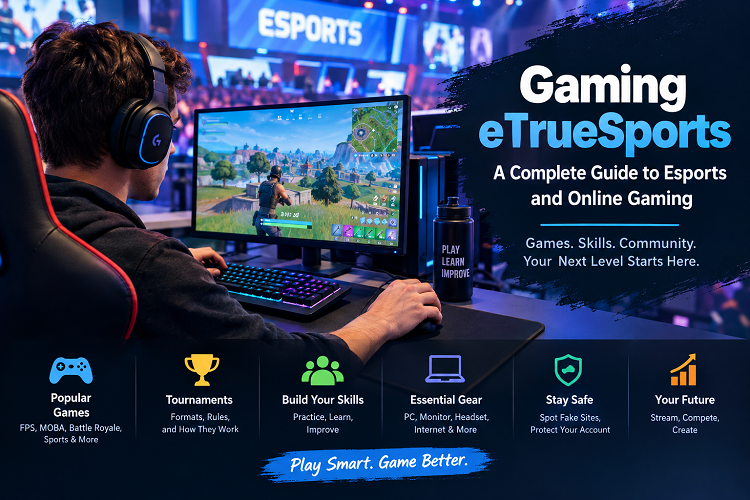
Competitive gaming has become a major part of the entertainment industry. Millions of players compete online, follow professional teams, and watch esports tournaments throughout the year. For newcomers, the scene offers plenty of opportunities to learn, compete, and connect with other players. The term gaming eTrueSports appears in searches related to esports, online gaming, competitive play, and gaming content. People looking for this term may want to explore gaming news, understand esports competitions, improve their skills, or learn more about websites associated with the name.
Yet there is more to competitive gaming than choosing a popular title and joining a match. Players also need to understand tournament formats, fair-play rules, equipment requirements, and online safety. Knowing where to find reliable information matters just as much.
This guide covers the essentials of gaming eTrueSports, explains how competitive gaming works, and offers practical advice for beginners. It also examines how to evaluate websites using the eTrueSports name without confusing an editorial publication with an actual gaming service.
One distinction deserves attention from the start: the name alone does not establish that a particular website operates tournaments, offers playable games, or provides a verified esports service. Readers should confirm those details through the relevant website’s official information.
Also Read: Get in Touch PlayBattleSquare
What Is Gaming eTrueSports?
Gaming eTrueSports is a search term associated with esports, gaming-related content, and competitive online play. Its precise meaning depends on the website or service a reader encounters.
Esports, short for electronic sports, involves organised competition through video games. Players compete individually or in teams under established rules, often with rankings, tournament brackets, or prize pools.
Casual gaming and esports share the same foundation, but their objectives often differ. Someone playing a multiplayer shooter with friends may simply want to have fun. A competitive team playing that game might spend hours studying maps, refining strategies, and reviewing match statistics.
Both involve gaming. The competitive setting adds structure, preparation, and measurable performance.
Gaming vs. Esports: Understanding the Difference
Gaming encompasses nearly every kind of video game activity, from single-player adventures to casual mobile games. Esports focuses on organised competition, where players work toward defined results.
The main categories include:
- Casual gaming: Players enjoy games for entertainment, exploration, or relaxation.
- Ranked gaming: Players compete in a ranking system that measures their performance against others.
- Amateur esports: Individuals and teams enter organised competitions without necessarily earning a living.
- Professional esports: Skilled players compete at a high level, sometimes earning salaries, sponsorships, or tournament prizes.
Gaming eTrueSports searches may lead to information about any of these activities. The specific website’s content determines which interpretation makes sense.
Games eTrueSports
Games eTrueSports is a gaming-related topic that attracts players interested in esports, competitive gaming, and the latest developments in the gaming industry. It can serve as a starting point for exploring popular game genres, competitive strategies, tournament news, and gaming trends. Players who enjoy esports can learn about team coordination, player performance, game mechanics, and the skills needed to compete at higher levels. Gaming platforms and informational websites may also cover new releases, community discussions, and tips for improving gameplay. However, readers should verify tournament schedules, game updates, and competition details through official sources to ensure the information is accurate and current.
What Does the eTrueSports Website Offer?
The eTrueSports name appears across websites with different domains and content. Identifying the exact site helps readers understand what it actually provides.
For example, eTrueSports.com describes itself as a blog covering esports, entertainment, and related news. Another site, eTrueSports.co, publishes articles covering sports, gaming, technology, and news.
These websites should not automatically be treated as the same service. Similar names do not prove common ownership, identical features, or shared editorial standards.
Types of Content You May Find
Depending on the website, gaming-related articles may cover several areas:
- Gaming news: Updates about releases, patches, industry developments, and upcoming features.
- Esports coverage: Stories about competitive teams, players, tournaments, and match results.
- Gaming guides: Tutorials covering game mechanics, settings, strategies, and progression.
- Technology articles: Information about gaming hardware, applications, and performance.
- Entertainment coverage: Stories about streamers, online communities, and gaming culture.
The quality of that information matters. Look for publication dates, identifiable authors, credible references, and links to primary sources. These details are especially useful when an article discusses a recent game update or an upcoming competition.
Is eTrueSports a Game or a Gaming Platform?
A gaming publication and a playable gaming platform serve different purposes.
An editorial website publishes articles and information. A gaming platform may provide matchmaking, player accounts, multiplayer services, or tournament registration. A video game, meanwhile, offers an interactive experience that people can play.
The available About Us information for eTrueSports.com describes a blog rather than a standalone video game.
That distinction does not establish what every similarly named website offers. Before creating an account, downloading software, or paying for access, check the specific service’s features and terms.
Popular Types of Competitive Gaming
Esports includes several genres, each with its own mechanics and demands. Some emphasise quick reactions, while others reward long-term planning, teamwork, or precise control.
Choosing the right genre can make the learning process more enjoyable.
1. First-Person Shooters
Games such as VALORANT and Counter-Strike 2 reward accurate aiming, smart positioning, communication, and tactical awareness.
Players must react quickly while coordinating with teammates. Understanding map layouts and anticipating opponents can be just as valuable as mechanical skill.
2. Multiplayer Online Battle Arenas
League of Legends represents the multiplayer online battle arena, or MOBA, genre.
These games combine character abilities, team coordination, resource management, and map control. Players must understand their individual roles while keeping track of the wider match.
3. Battle Royale Games
Fortnite is a well-known example of the battle royale format.
Players compete to survive while the playable area or match conditions change. Positioning, resource management, situational awareness, and timing all influence the outcome.
4. Sports and Racing Games
Sports simulations and racing games appeal to fans who enjoy familiar competitive formats.
Success often depends on timing, precise controls, tactical decisions, and consistency. Players may compete individually or represent teams in organised events.
5. Mobile Esports
Mobile gaming has made competitive play accessible to people who do not own a gaming PC or console.
However, device performance, touch controls, battery life, and network stability can affect the experience. Players should choose games that run reliably on their devices before entering competitive matches.
How Online Esports Competitions Work
Esports tournaments follow specific formats that determine how participants advance and how organisers identify a winner. Understanding these structures helps players prepare and gives spectators a clearer picture of each event.
Common Tournament Formats
Single elimination: A participant or team exits after losing its elimination match. The format is straightforward, but one defeat can end a tournament run.
Double elimination: Competitors usually have another route through a lower bracket after their first loss. This format offers a second chance but often requires more matches.
Round robin: Each participant or team faces every other participant in its group. Organisers use the published scoring system and tiebreaking rules to determine the standings.
League format: Teams compete over a scheduled series of matches. Results accumulate over time, so consistent performance becomes especially important.
Battle royale scoring: Organisers may award points for placement, eliminations, or other game-specific achievements. The scoring system depends on the event.
Official competitions publish rules covering eligibility, match procedures, player conduct, and scoring. Epic Games, for example, publishes official rules for its Fortnite competitive events.
Before entering a tournament, read the rules for that specific competition. Events featuring the same game may still have different eligibility requirements, formats, or restrictions.
How to Get Started With Gaming at eTrueSports
You do not need professional equipment or years of experience to begin learning competitive gaming. A sensible plan, regular practice, and realistic goals provide a stronger starting point than expensive accessories alone.
Step 1: Choose One Game
Start with a game that interests you and runs well on your current device.
Focusing on one title gives you time to understand its mechanics, maps, controls, and competitive environment. You can explore other games once you have established a comfortable routine.
Step 2: Learn the Fundamentals
Before attempting advanced strategies, understand the game’s basic objectives and rules.
Learn how movement works, what each ability does, how scoring operates, and which decisions commonly lead to mistakes. A strong foundation makes more advanced lessons easier to apply.
Step 3: Practice With a Purpose
Avoid treating every gaming session as an opportunity to accumulate hours.
Instead, choose one skill to improve. You might work on aiming, learn an unfamiliar map, communicate more clearly, or make better decisions under pressure.
Step 4: Review Your Performance
Match statistics and gameplay recordings can reveal patterns you might miss while playing.
Look for recurring problems. Perhaps you take unnecessary risks, miss important information, or struggle to coordinate with teammates. Choose one issue and work on it during your next session.
Step 5: Join a Gaming Community
Look for beginner-friendly groups, moderated communities, or official game channels.
These spaces can help you find teammates, exchange advice, and learn about competitions. Follow community rules and avoid groups that encourage cheating or harassment.
Step 6: Try a Beginner Tournament
Once you understand the game and its rules, consider entering a friendly competition or amateur event.
Check the organizer’s identity, eligibility requirements, match format, and any entry fees. You should understand the conditions before committing your time or money.
A Practical Training Example
Consider a beginner who wants to improve at a team-based shooter.
Instead of playing several hours without a plan, the player could structure a one-hour session like this:
- 15 minutes: Warm up and practice aiming.
- 30 minutes: Play focused matches while applying one specific skill.
- 15 minutes: Review mistakes and choose an improvement goal for the next session.
This routine connects practice with feedback. The player works on a skill, tests it in actual matches, and uses the results to guide future training.
The schedule can change according to experience and availability. What matters most is having a clear purpose for each session.
Essential Equipment for Competitive Gaming
Your equipment influences how comfortably and consistently you can play. However, the best setup depends on the game, your budget, and the limitations of your existing hardware.
| Equipment | What to Look For | Why It Matters |
|---|---|---|
| Gaming PC or console | Reliable performance in your chosen game | Supports consistent gameplay |
| Monitor or display | Clear visuals and a suitable refresh rate | Makes visual information easier to follow |
| Mouse and keyboard or controller | Comfortable, responsive controls | Supports accurate and repeatable inputs |
| Headset | Clear audio and a comfortable fit | Helps with game sounds and communication |
| Internet connection | Stability and low latency | Reduces delays and connection problems |
| Desk and chair | Comfortable positioning and suitable support | Helps reduce physical discomfort during sessions |
Do You Need Expensive Gaming Gear?
No. Expensive equipment cannot replace practice, game knowledge, or good decision-making.
A modest setup can support meaningful progress if it runs your chosen game reliably. Upgrades become worthwhile when you identify a specific problem that affects performance.
For example, unstable internet may disrupt competitive matches more than a premium headset would improve them. Similarly, a comfortable controller may offer more practical value than an expensive accessory with little impact on gameplay.
Start with reliability and comfort. Upgrade only when you understand what needs improvement.
Skills That Help Players Improve
Competitive gaming combines mechanical ability, strategic thinking, communication, and emotional control. Strong players develop these areas together rather than relying on quick reactions alone.
Mechanical Skills
Mechanical skills include aiming, movement, timing, and control accuracy.
Their importance varies by genre, but consistency usually matters more than occasional impressive performances. A shooter player might practice crosshair placement, while a racing player might focus on braking points and cornering.
Choose drills that address your weakest mechanics instead of repeating skills you have already mastered.
Game Knowledge
Understanding a game’s rules and systems helps you make better decisions.
Learn character abilities, map layouts, objectives, item effects, and scoring mechanics. This knowledge also helps you anticipate opponents and recognize opportunities before they become obvious.
For example, knowing a common defensive position may help your team plan a safer approach.
Communication and Teamwork
Team-based games require useful, timely communication.
Share relevant information, coordinate plans, and avoid blaming teammates whenever a match goes wrong. Short, specific messages are generally more helpful than emotional commentary.
A clear call about an opponent’s location or your team’s next move can help everyone respond more effectively.
Strategic Thinking
A good strategy accounts for the current situation rather than following a fixed plan regardless of circumstances.
Imagine a team leading late in a match. Taking unnecessary risks could give the opponent an opportunity to recover. Protecting the advantage may be the smarter decision.
Competitive players must recognize when to attack, when to defend, and when to change their approach.
Emotional Control
Frustration can affect judgment, particularly after several losses.
Players who respond emotionally may rush decisions or communicate poorly. Taking a short break can help restore concentration and prevent a difficult session from becoming unproductive.
Treat losses as opportunities to identify mistakes, not as proof that improvement is impossible.
Pros and Cons of Gaming eTrueSports
The advantages and disadvantages depend on how you use the term. Some readers want gaming information, while others hope to enter competitions or develop their skills.
Potential Benefits
- Convenient information: Gaming publications can help readers discover updates, new titles, and industry developments.
- Skill development: Competitive play encourages strategic thinking, practice, and problem-solving.
- Social connections: Multiplayer games can help people build friendships and coordinate with teammates.
- Accessible entry points: Free-to-play games and community competitions may reduce initial costs.
- Career exploration: Experienced players may pursue streaming, coaching, tournament operations, or gaming content creation.
These benefits are possible, not guaranteed. Results depend on the individual, the game, and the opportunities available.
Potential Drawbacks
- Unverified information: Some websites publish claims without sufficient supporting evidence.
- Time demands: Competitive improvement may require regular, focused practice.
- Equipment expenses: Hardware, peripherals, subscriptions, and game purchases can add up.
- Online toxicity: Harassment and unsportsmanlike behavior can damage the gaming experience.
- Financial risks: Certain competitions and third-party services involve fees or questionable offers.
- Uncertain career prospects: Professional gaming and content creation involve considerable competition and unpredictable income.
The sensible approach is to enjoy gaming without assuming that every competition or career opportunity will deliver a financial return. Set spending limits, manage your time, and evaluate offers carefully.
Is eTrueSports Legitimate and Safe to Use?
Readers should evaluate the exact website or service rather than judging it by its name alone.
A publication may offer useful gaming articles without operating a tournament platform. Similarly, a polished website does not automatically establish that a service is safe.
A January 2026 article from The Mac Observer raised concerns about a service using the eTrueSports name, including questions about its gaming claims and an associated iOS app. That reporting should be considered in context, with attention to the specific service discussed.
It would be inaccurate to assume that every similarly named website shares the same ownership, features, or risks.
A Practical Safety Checklist
Before using a gaming website, take a few basic precautions:
- Verify the domain: Check the spelling and address carefully to avoid imitation websites.
- Check the publisher: Look for author details, contact information, an About page, and editorial policies.
- Confirm important claims: Consult official publishers and tournament organizers for game updates, schedules, and results.
- Review app permissions: Question requests for access that appears unrelated to an application’s purpose.
- Protect your accounts: Use unique passwords and enable multifactor authentication when available.
- Avoid suspicious downloads: Do not install unknown files or tools that promise better performance without credible evidence.
- Understand payment terms: Check the organizer, entry requirements, and refund policy before paying.
Be especially cautious of claims promising guaranteed wins, effortless professional earnings, or exclusive benefits without verifiable evidence.
For competition-specific information, consult official resources such as the Riot Games Competitive Operations library or the relevant game’s publisher. Official documentation is generally a better starting point for rules and eligibility than an unverified third-party summary.
Expert Tips for Better Gaming Performance
Improvement rarely comes from one dramatic change. Consistent practice, thoughtful adjustments, and useful feedback are more reliable ways to develop competitive skills.
Set Measurable Goals
Replace vague goals such as “play better” with something you can evaluate.
You might aim to improve accuracy, reduce avoidable deaths, learn two unfamiliar maps, or communicate more consistently. Choose goals that match the game and your current skill level.
Track Your Progress
Record a few useful statistics after each session.
Depending on the game, these might include accuracy, win rate, objective participation, or recurring mistakes. Review trends over several sessions rather than judging your ability from one result.
Performance naturally varies, and a single match rarely tells the whole story.
Learn From Experienced Players
Watch skilled players who explain their decisions. Pay attention to positioning, timing, resource management, and teamwork.
Professional strategies often depend on extensive practice and coordinated teams. Focus on understanding the reasoning behind a decision, then adapt that principle to your own experience.
Adjust Your Settings Carefully
Sensitivity, key bindings, audio levels, and display settings can influence comfort and consistency.
Change one setting at a time so you can evaluate the result. Constantly switching configurations can make it harder to develop reliable muscle memory.
Protect Your Physical Well-Being
Take regular breaks, maintain a comfortable posture, and position your screen at a suitable distance. If you experience persistent pain or eye strain, stop and address the problem.
Sleep matters, too. Fatigue can affect attention, reaction time, and decision-making, even when you feel eager to keep playing.
Follow Fair-Play Rules
Avoid cheats, unauthorized scripts, prohibited exploits, and account-boosting services that violate a game’s rules.
These practices can lead to penalties or account restrictions. They also undermine the experience for other players.
Long-term improvement comes from learning the game and developing reliable skills, not from searching for shortcuts.
Gaming eTrueSports Compared With Other Gaming Resources
Different gaming resources serve different purposes. Knowing what each one provides helps you choose the right source for a particular task.
| Resource Type | Primary Purpose | Best Use |
|---|---|---|
| Gaming news website | Publish articles and industry updates | Discover developments and new releases |
| Official game website | Provide publisher announcements and resources | Verify game information |
| Esports tournament website | Publish event rules, schedules, and results | Find and evaluate competitions |
| Streaming platform | Broadcast gameplay and discussions | Watch matches and study strategies |
| Gaming community | Connect players and exchange advice | Find teammates and discuss games |
| Gaming eTrueSports search results | Lead readers to relevant content or services | Identify the specific website and assess its purpose |
These categories can overlap. A gaming publication may cover esports news, while a tournament organizer may also publish guides and educational content.
The key is to understand what a source actually does. Original reporting, official announcements, community opinions, and gaming services are not interchangeable.
If you are researching gaming eTrueSports, begin with the exact domain. Then determine whether the content matches your needs and whether important claims have reliable supporting evidence.
(FAQs): About Gaming eTrueSports
1. What is gaming eTrueSports?
Gaming eTrueSports is a search term associated with esports, competitive gaming, gaming news, and related online content. Its precise meaning depends on the website or service being discussed. Check the exact domain before assuming it offers playable games or tournament services.
2. Is eTrueSports an actual video game?
The available About Us information for eTrueSports.com describes it as a blog covering esports, entertainment, and related topics. This does not establish that the website is a standalone video game.
3. Can beginners use eTrueSports to learn about esports?
Potentially, depending on the content available on the specific website. Look for clear explanations, useful examples, credible sources, and accurate publication dates. Verify competitive rules and game updates through official publishers whenever possible.
4. Does eTrueSports host gaming tournaments?
The name alone does not confirm tournament hosting. Check the website’s official information to determine whether it provides event registration, matchmaking, or competition management. Verify the organizer and rules before paying an entry fee.
5. Which games are popular in esports?
Competitive gaming includes first-person shooters, multiplayer online battle arenas, battle royale games, sports simulations, and mobile games. Examples include VALORANT, Counter-Strike 2, League of Legends, and Fortnite. Competitive opportunities vary by game, region, and event.
6. Do I need a gaming PC to participate in esports?
No. Some competitive games support consoles or mobile devices. Choose a game that works with your existing equipment and offers a competitive environment suited to your interests.
7. Can you make money through competitive gaming?
Some players earn income through tournament prizes, salaries, sponsorships, streaming, or coaching. However, these opportunities are competitive, and income is never guaranteed. Beginners should avoid spending money they cannot afford to lose.
8. How can I tell whether an eTrueSports website is trustworthy?
Review the domain, ownership information, author details, privacy policy, and contact information. Verify important claims with official publishers and tournament organizers. Avoid suspicious downloads and requests for sensitive account information.
9. Is gaming eTrueSports suitable for mobile gamers?
Gaming-related articles can help mobile players learn about esports, game updates, and gaming technology. Whether a particular eTrueSports website offers mobile apps or mobile-specific services must be confirmed independently.
10. How can I improve my competitive gaming skills?
Choose one game, practice specific mechanics, review your mistakes, and learn from experienced players. Maintain a realistic routine and track your progress. Focus on consistent improvement instead of expecting to win every match.
Conclusion: Gaming eTrueSports
Gaming eTrueSports is a relevant search topic for people exploring esports, competitive gaming, and related online content. Still, the name alone does not reveal whether a particular website publishes articles, provides gaming services, or organizes tournaments.
Start by identifying the exact website and reviewing its published information. Use official sources to confirm game updates, tournament rules, and event schedules.
If you want to improve as a player, focus on consistent practice, game knowledge, communication, and fair play. You do not need expensive equipment or professional experience to begin learning.
Most importantly, approach competitive gaming with curiosity and realistic expectations. Reliable information, a practical training routine, and good online habits can help you enjoy esports while making informed decisions about where you spend your time and money.
One thought on “Gaming eTrueSports: Esports Guide for Beginners 2026”